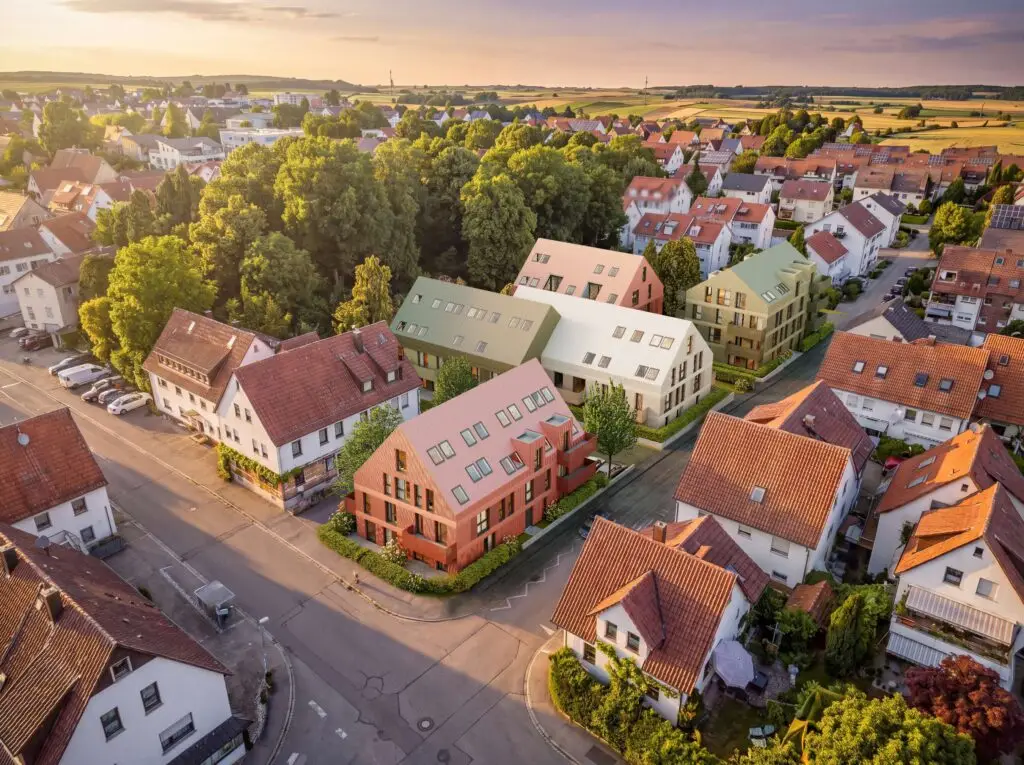
Five Gardens

On a spacious lot in Leonberg-Höfingen, an ensemble-style residential neighborhood is being developed, consisting of a total of four apartment buildings with 55 residential units. The buildings are arranged in such a way that clear spatial boundaries are defined while simultaneously creating an open, green central area. One of the buildings is divided into two sections by a slight offset, which breaks up the scale and achieves a more subtle integration into the surroundings.
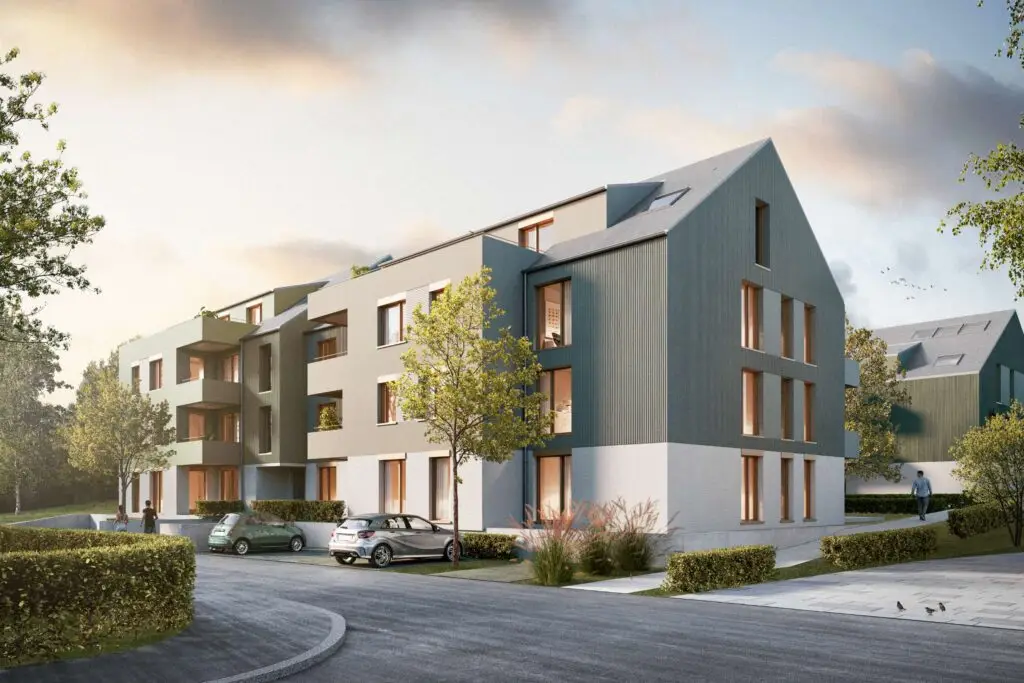
The NUO

Two apartment buildings are being constructed on a spacious lot; they are designed as independent structures while simultaneously forming a cohesive, community-oriented residential complex. The architectural concept is based on a clear structure: Each building is divided into two volumes by a slight offset. This differentiation allows the project to scale appropriately to its surroundings and gives the complex a pleasant sense of intimacy despite its size. In total, the project comprises 46 residential units with a well-thought-out access and circulation system. The required parking spaces are primarily located in an underground garage, allowing the above-ground areas to remain largely car-free and be used as high-quality open spaces.

48.777° N, 9.197° E
From Method to Results.

This is how we decipher the conditions that give rise to good architecture.

Every project is unique—not because we seek uniqueness, but because every project involves different people, different locations, different circumstances, and different goals.

We don't believe in architecture as a style. We believe in architecture as the result of relationships. That's why our work doesn't begin with a design, but with the question of why a project should be built right here—and what relationships exist between people, investors, and cities.

Our Method

We listen. We observe. We let the place be our teacher. The design is not the starting point. Understanding the levels of relationship is.

Many projects start with an idea or a form. We take the opposite approach. We view every building project first and foremost as a complex interplay of people, location, economic viability, sustainability, use, building codes, and cultural context.

Architecture begins only when these connections become apparent. This is where the true story of unique.studio begins. That is why we do not view our work as the invention of spectacular forms.

We see it as the ability to bring order to complexity and, from that, develop a solution that is logical, economical, and humane all at once. We call this the unique.studio method.

The Five Principles Behind a unique.studio Architecture

01 | The Search for Clues

Every place already tells a story. Even before we start drawing, we look for the traces that define it: its history, its topography, its neighborhood, its culture, its potential, and its conflicts. We listen before we design.

02 | Understanding

Architecture is about more than just square meters. We analyze “hard” factors—such as building codes, budget, sustainability, and cost-effectiveness—just as thoroughly as “soft” factors: human perception, identity, community, and quality of life. After all, successful buildings emerge where these two worlds come together.

03 | Structuring

Architecture is about more than just square meters. We analyze “hard” factors—such as building codes, budget, sustainability, and cost-effectiveness—just as thoroughly as “soft” factors: human perception, identity, community, and quality of life. After all, successful buildings emerge where these two worlds come together.

04 | The Search for Identity

We don’t design a style. We develop an identity. Every project has its own character, which we bring to light by asking the right questions. The architecture becomes the logical consequence of its location.

05 | Implementation

Visions are valuable only if they can be realized. We support projects from the initial analysis through to implementation, combining design quality with technical precision, economic soundness, and a commitment to the long term.

Overview of Services

Are you looking for character and substance—rather than compromise and showmanship? Good for you: unique.studio delivers architecture rooted in the local context rather than imported designs.

Housing is about much more than just efficient floor plans. We design buildings that are economically viable while also fostering a sense of identity. Light, proportion, everyday life, community, and sustainability are all taken into account from the very beginning to create housing that works in the long term.

A neighborhood is more than the sum of its buildings. We develop urban spaces where mobility, open space, landscape, social interaction, and economic development work together. Our goal is to create places that blend naturally into their surroundings while still developing their own identity.

Affordable housing deserves the same design quality as any other project. We combine cost-effectiveness with a high quality of life and develop solutions that both fulfill our social responsibility and stand the test of time.

Residential, commercial, dining, and public spaces are increasingly converging. We develop buildings that intelligently combine different functions, thereby creating vibrant places.

Not every project begins with architecture. Many begin with a decision. We support investors, project developers, and building owners from the earliest stages with feasibility studies, site analyses, potential assessments, land-use concepts, and strategic considerations.

For us, competitions are think tanks. They allow us to develop new solutions to social, environmental, and urban planning challenges. Many of our most influential ideas are born right here.

Every type of use has its own dynamics. We design buildings that are both functionally sound and create a welcoming atmosphere—from urban boarding houses to housing designed for multiple generations.

Guiding Principles
Architecture begins with listening. Every place has its own identity and offers an architecture of relationships. Beauty does not arise by chance. Cost-effectiveness is not the enemy of good design. Sustainability is not an afterthought—it is a vital responsibility. Good buildings age gracefully. People don’t remember floor plans— they remember places.
Replies
Questions we're often asked.

For us, the name “unique.studio” is not just a marketing promise. It describes a commitment. Every architectural project involves different people, different locations, different economic conditions, different cultural influences, and different goals. When all these parameters are taken seriously, the result cannot be generic. A specific solution inevitably emerges.

That is precisely why our studio is called unique.studio—not because we want to be different, but because we are convinced that every project deserves its own architectural response.

The unique.studio method describes our way of thinking. We don’t start with forms or a design concept. We start by understanding a project. We analyze the site, the people, the economic goals, the urban context, ecological requirements, and the identity of a project.

Only when these connections become clear does architecture begin for us. We believe that good architecture isn’t invented—it’s discovered.

Because every good decision is based on a deep understanding. Many view architecture as a creative process. For us, however, creativity does not begin with the first draft, but with the right questions. Those who truly understand a place recognize opportunities, potential, and connections that remain hidden at first glance.

Analysis lays the foundation for decisions that are not only compelling from a design perspective, but also economically viable, sustainable, and sensible in the long term.

Every place tells a story even before the first building is constructed. We describe our first step in the project as “searching for clues.” We strive to understand what shapes a place—its history, its landscape, its neighborhood, its culture, its atmosphere, and the people who will use it.

We’re not just interested in visible characteristics. Often, it’s the unassuming details that later define a project’s character. Our task is to interpret these clues and use them to develop architecture that feels natural while also possessing its own distinct identity.

We do not believe in a conflict between economic thinking and good architecture.

A successful project emerges when both aspects come together. Good design fosters a sense of connection, improves marketing, builds acceptance, and enhances a building’s long-term quality. Economic viability, in turn, ensures that architecture can be realized in the first place.

That is why we view budget, building codes, sustainability, and design not as competing interests, but as components of the same task. The best projects emerge where these elements reinforce one another.

Architecture isn’t just built—it’s experienced. Our work is based on the conviction that the quality of a building lies not solely in its form, but in the relationship between people and space. How we perceive light, how we orient ourselves, the atmosphere a place exudes, and whether we feel comfortable there—all of these factors determine whether architecture truly works.

That is why we engage deeply with insights from architectural theory, the psychology of perception, and neuroaesthetics. Because we want to create spaces that people not only use, but with which they identify.

For us, sustainability is not just another discipline. It is the foundation of responsible architecture.

A sustainable building does not merely impress with its energy efficiency or materials. It remains relevant for decades, is embraced by people, can be used flexibly, and blends naturally into its urban context.

That is why we always view sustainability holistically—ecologically, economically, and socially. Our goal is to create places that will endure over the long term and offer genuine added value to future generations.

Architecture knows no national borders. From an early stage, our collaboration with people from different cultures has shaped who we are. Today, our team is international in composition, draws on a wide variety of perspectives, and has networks in many regions of the world. This diversity broadens our view of architecture and helps us develop solutions that go far beyond local ways of thinking.

At the same time, for us, internationality is more than just a market—it is a personal driving force. We want to work where architecture shapes cities, accompanies social developments, and creates places that retain their significance across generations.

Our goal is to contribute to projects that leave a visible mark—not only in Germany, but wherever good architecture brings people together. This passion drives us every day and is an essential part of what makes unique.studio unique.

So what now?

Every project begins with a question.

Let's work together to find the answer that lies within your project.

Be unique
DRAG